The strike price
The fixed price per megawatt-hour (MWh) agreed in the auction.

You may be thinking, with so many new developments and the UK’s need to generate more renewable energy, what do government initiatives such as the Contract for Difference scheme do to benefit everyone, from developers to consumers? This blog will break down how the Contracts for Difference (CfD) works and the meaning behind the auctions and strike prices when it comes to buying and selling renewable energy.
If you have not yet come across or heard of the Contract for Difference (CfD), it is a government-led initiative that allows for new renewable generation to be financed.
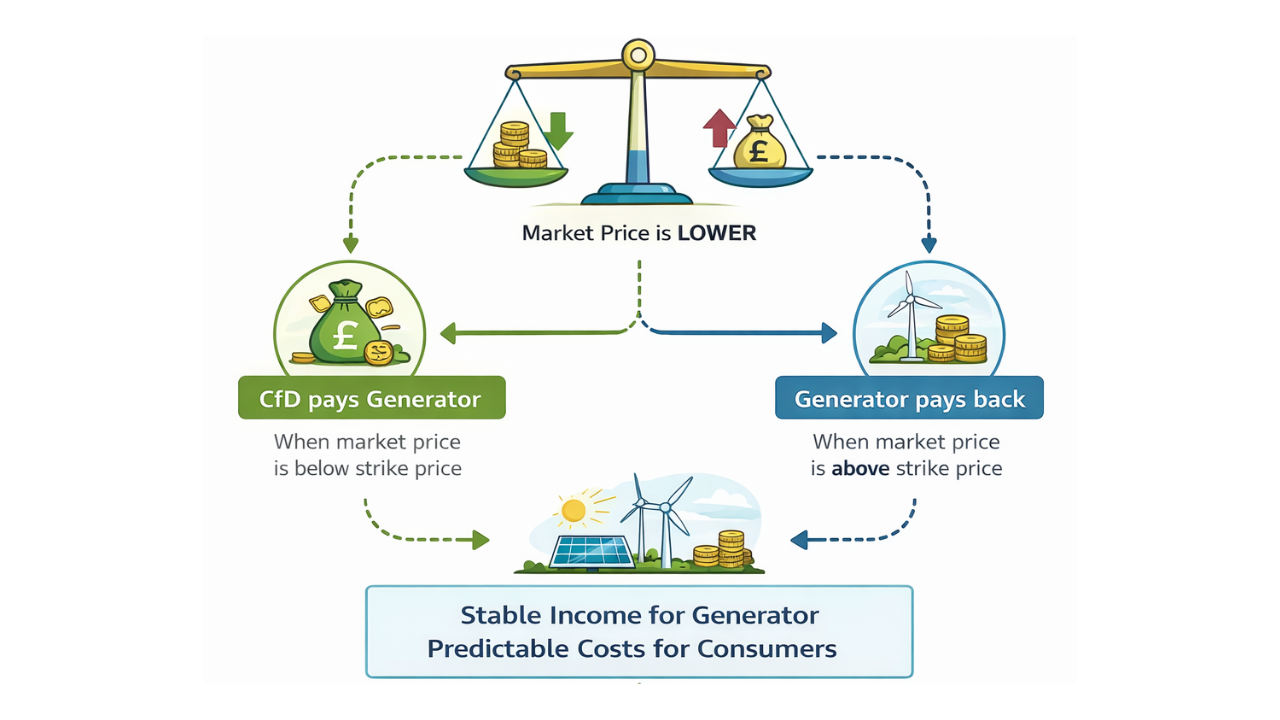
The CfD is a contract between a low-carbon generator and a government-owned counterparty, the Low Carbon Contracts Company (LCCC). This simply secures the long term price stabilisation between the two contracts and allows generators to receive a fixed price for each unit of electricity they produce, which is otherwise known as the strike price. These types of deals usually last 15 years.
What does this mean?
The generators will sell the electricity that they produce into the market normally, the CfD comes into play to ensure that the revenue the generators receive meets the agreed strike price, rather than the current state of the volatile energy market.
The strike price
The fixed price per megawatt-hour (MWh) agreed in the auction.
The reference price
A measure of the actual wholesale market price for that technology and time period.
Why are auctions used?
Instead of the government setting the strike prices, in the UK we use competitive auctions, otherwise known as 'allocation rounds' to determine the most competitive price.
In each allocation round, renewable developers submit bids stating the lowest strike price at which they are willing to build and operate their projects. This process helps show the real cost of renewable power and pushes strike prices down over time through competition and innovation.
Strike prices matter for bills in two main ways.
Strike prices matter for bills because they determine the direct cost or saving from the Contract for Difference (CfDs). For example, when wholesale prices are above strike prices, CfD generators return the money, reducing overall system costs and avoiding charging customers high prices for the electricity generated.
Secondly, and more importantly in the long run, CfDs influence the structure of the UK's generation mix.
In wholesale electricity markets, prices are set by the marginal generator, usually the most expensive plant needed to meet demand at that moment. When more wind and solar enter the system, they displace gas-fired generation more often. This pushes the marginal price down, a phenomenon known as the merit order effect.
However, even with higher strike prices, these projects can still benefit the system if they reduce reliance on gas and help stabilise wholesale prices over the long term.
If you need help with your business gas or electricity, get in touch with us!
If you would like a free quote, please fill in the box below, or…
Contact us on 0161 521 3400 or email us at info@purelyenergy.co.uk
Written By Faith Labong at Purely Energy
We don't just find you a better rate and disappear. From procurement to monitoring to metering services, we work alongside you for the long haul. Because when your business thrives, so does ours.
Arrange a callback or call us directly on 0161 521 3400



Your Kind of Energy Broker
Purely Energy Ltd (13393163)
VAT Number: 449820074
Purely Energy,
810 Sterling House,
Warrington,
England
WA1 1GG
WhatsApp: 0747 833 9990
Purely Energy Portal
Complaints Handling Procedure