
Half-Hourly Electricity Meters Explained

Published 23 October 2024 · Last reviewed 8 June 2026

Understand half-hourly electricity meters, why businesses use them, what they cost, and what the market-wide half-hourly settlement programme means for your site.
What is a Half-Hourly meter (HH meter)
A half-hourly meter is a type of electricity meter used by businesses, typically those with high usage. It records the user’s energy consumption at half-hourly intervals 24/7. Usage data is automatically sent straight to the supplier, so you won’t need to take manual readings. A Half-Hourly Meter can handle a larger capacity than a standard meter, which is why it is typically used by businesses that consume more energy, such as factories or warehouses.
What does a Half-Hourly meter look like?
Below is what a half hourly meter looks like. You will also find a meter serial number on the front of the meter (we have crossed this out in red)
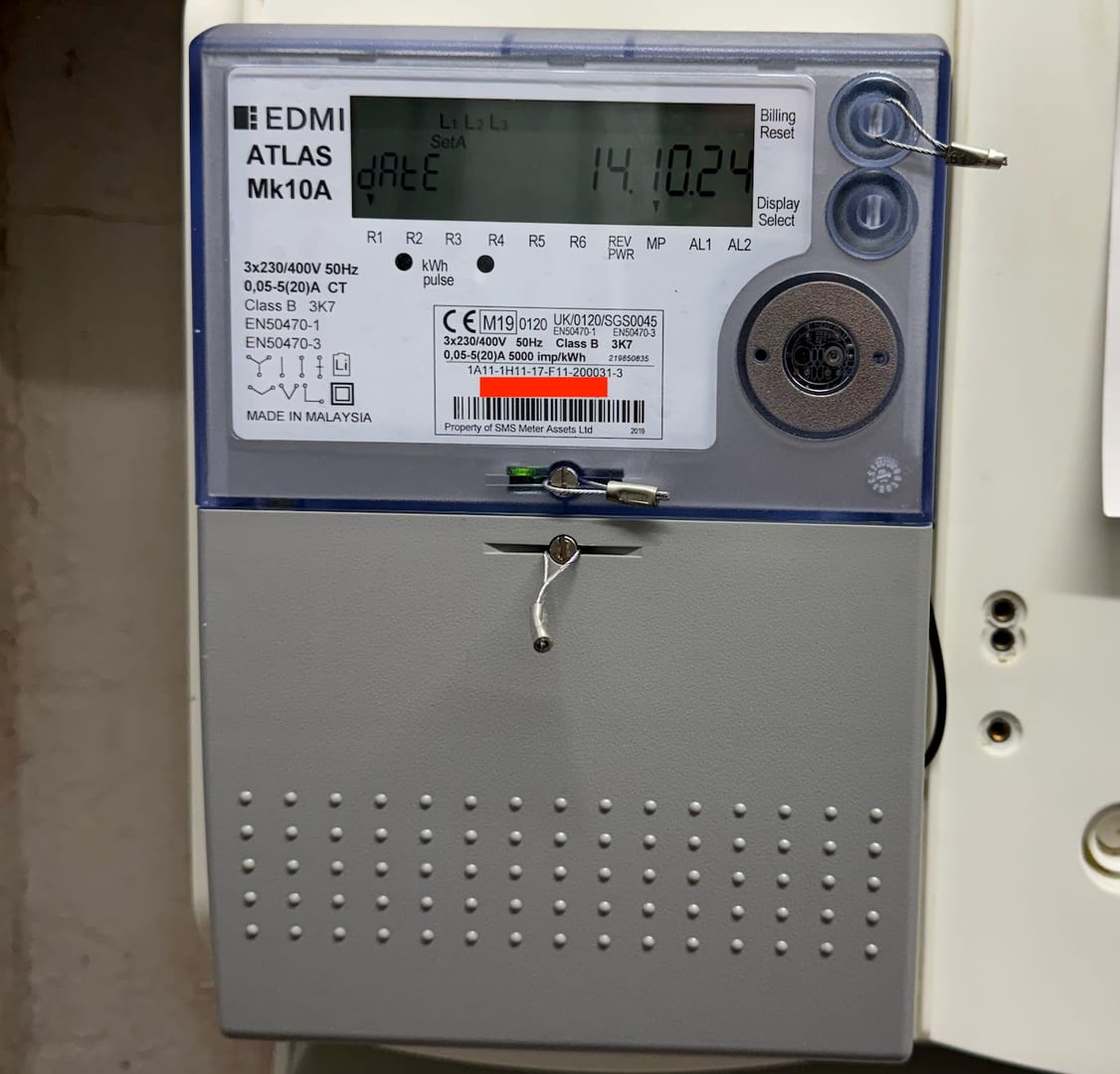
If you are unsure on if you have a half hourly meter or not here are four key identifiers:
- Metal ring on the front of meter: this is for cell signal as all half hourly meters or have to be connected via a sim card to submit readings. (specifically, to hold the magnetised communication head when in operation).
- Higher standing Charge: standing charges are commonly higher on half-hourly supplies than on comparable non-half-hourly supplies, reflecting the metering and data infrastructure involved. How much higher varies by supplier, network region and contract, so treat any single figure with caution and ask for the actual breakdown.
- Non-smart (traditional) metering:
- Meter Serial Number, on your electricity meter, you will have a meter serial number ( in red on image above). If you send in your meter serial number we can identify if your meter is Half hourly and provide an estimate on your standing charge cost.
Are Half-Hourly meters more expensive?
Generally, HH meters come at higher costs than usual meters. Whether half-hourly metering leaves you better or worse off depends entirely on the site. If your consumption genuinely warrants it, accurate settlement, access to time-of-use pricing and the ability to evidence your load profile when tendering will usually outweigh the additional fixed charges. If your consumption does not warrant it, and you are not required to be half-hourly, the additional charges are a real cost with little to offset them. This is worth modelling properly rather than assuming either way.
There are two types of Half Hourly Meters:
- Whole Current (WC) meters.
Whole current (WC) metering is wired directly into the supply so the full current passes through the meter. It is used on smaller low-voltage supplies. The Balancing and Settlement Code's Codes of Practice for low-voltage metering apply to circuits fused at 100 amps or less per phase, which gives a useful sense of where whole current metering sits.
- Current Transformer (CT) meter.
Current transformer (CT) metering does not carry the full load. Current transformers wrap around the supply conductors and pass a scaled-down measurement to the meter, which is then multiplied back up. CT metering is used on larger supplies, including high-voltage and extra-high-voltage connections. The practical difference on your bill is that CT-metered sites almost always have an agreed available capacity in kVA, and pay a capacity charge for it. That charge reserves capacity on the distribution network for your site whether you use it or not.
You will notice a Capacity Charge on your electricity bills if you have a CT meter. Capacity charge is a fee to reserve and allocate energy on the network for your energy supply.
All Half Hourly Meter customers must also pay Meter Operator (MOP) charges. Your Meter Operator is accountable for installing and sustaining your Half Hourly Meter. A MOP fee is a charge to cover the costs of any services provided by your meter operator. The charges are outlined in a MOP contract, which can be arranged through your supplier or independently.
Standing charges may also be higher if you have a Half-Hourly Meter. However, due to the reporting frequency, half-hourly meters allow for greater billing accuracy, ensuring you only pay for the energy that you use.
You should double-check your kVA usage because if you continuously use less than your kVA allowance, you could downgrade your meter, lowering your charges. Downgrading your meter can be expensive in the short term due to the manual labour involved, but in the long term, you will save money through cheaper energy bills. If you are still trying to figure out whether a downgrade would benefit your company, then contact us, and our team of experts will be more than happy to assist you.
Ways you can reduce your energy costs:
- Reduce your kVA, fall down a banding in the Targeted Charging Review bands.
- Staggering breaks, fewer people working machinery all at once = less kVA used.
- Performing specific tasks overnight, e.g. charging forklifts and electric vehicles/equipment. If you plan on doing this, we recommend a two-rate meter (day/night) to make the most out of your cheaper night rates.
Do I need a Half Hourly (HH) meter?
Half-hourly settlement was made mandatory for larger non-domestic sites in Profile Classes 5 to 8 by BSC Modification P272, which Ofgem directed on 29 October 2014 and which took effect on 1 April 2017.
Whether your own site must be half-hourly metered is driven by the maximum demand recorded against your connection and the terms of your connection agreement, so ask your DNO for the threshold that applies to your specific connection.
A profile class of 00 on the top line of your MPAN means the supply is half-hourly settled. This is the definitive test today, although profile classes are being retired as part of the MHHS programme described below.
The P272 legislation was introduced to ensure the country’s energy needs are met. Companies that use a higher amount of energy were targeted first, as any changes or fluctuations in their energy usage will most affect demand.
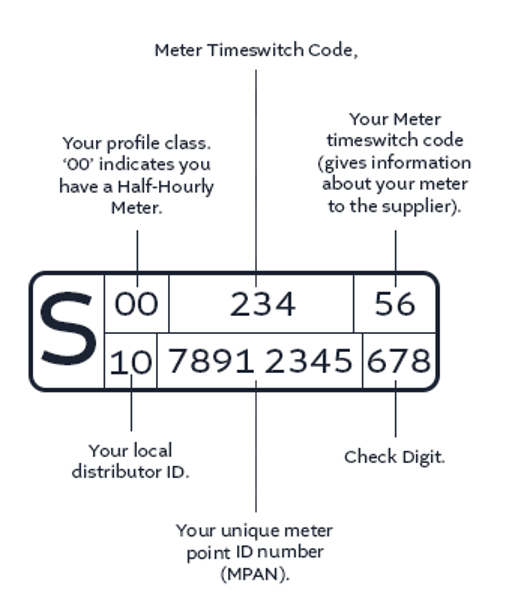
Separately, the MHHS programme is moving every electricity supply point in Great Britain onto half-hourly settlement. That is a change to how your consumption is settled behind the scenes, not an instruction to replace your meter.
Why Are Half Hourly (HH) Meters Better for the Grid?
- Efficiency: The grid becomes more efficient, as real-time data enables operators to balance supply and demand more effectively.
- Cost Reduction: The overall cost of energy falls as inefficiencies are reduced, allowing for optimised energy operations.
- Peak Demand Reduction: Energy usage is reduced during peak times, making the grid more stable through a demand-response strategy.
- Greener Future: HH meters support our net zero goal by helping grid operators predict and manage energy demand more accurately. Grid operators can track peak demand times, encourage consumers to adjust usage habits, and introduce them to renewable energy sources.
What is Market-wide half-hourly settlement (MHHS)?
MHHS is the programme moving all electricity supply points in Great Britain onto half-hourly settlement, with full transition due on 7 May 2027 and the new settlement timetable taking effect from 2 July 2027. Elexon was appointed by Ofgem in April 2021 as Senior Responsible Owner and MHHS Implementation Manager, and coordinates the work of more than 250 organisations across the sector.
Market-wide half-hourly settlement will remove the current meter types (Half Hourly / Non Half Hourly) and replace them with three new meter categories, which will be:
- Smart metering
- Advanced Metering
- Unmetered supplies
Most consumers have a non half hourly (NHH) meter, which means because there are not as frequent meter readings, meter readings are not entirely accurate and as a result there will be an imbalance between supply and demand.
MHHS obligations sit with suppliers and market participants, not with you. All suppliers must be able to access MPANs under the new Target Operating Model by 28 October 2026, and migration of around 33 million MPANs is due to complete on 7 May 2027. You do not need to replace your meter to comply, although your supplier may contact you about an upgrade. The timeline for these changes is:
How Will Market Wide Half Hourly Settlement (MHHS) Affect Your Energy Bill?
The supplier and the grid both benefit by shifting the load to off-peak times. A flatter demand curve means power facilities can operate closer to maximum capacity instead of relying on expensive backup power during peak demand. As the grid becomes more efficient, the cost of energy decreases.

Peak Demand Reduction: Consumers can use less energy during peak times, and more when renewable energy is available, decreasing fossil fuel use and reducing price volatility.

Cheaper Procurement Costs: With the help of predictive analytics from HH and smart meters, energy companies better understand consumer usage patterns and trends.
Using this data, suppliers can develop smarter procurement systems. Energy can be purchased in real-time when prices are expected to be lower, driving down costs through competition and reducing overall energy prices.
If you are not legally required to upgrade to an Half Hourly meter, upgrading may not be advisable, as it could increase your energy bills. However, if you have moved into a new premises with an inherited Half hourly meter, we can look to change from a CT to WC which may reduce the standing charge considerably
We will gladly assist you if you have moved into a new premises and inherited a HH meter and would like help lowering your energy costs. Contact us on 0161 521 3400 or email us at Info@purelyenergy.co.uk for any queries, and we will advise you on your next steps to ensure you can attain the lowest energy bills possible.
This Article was written by Megan Glover of Purely Energy. If there are any suggestions or questions - Please get in touch with us.
© 2026 Purely Energy Ltd. Terms of use.
How we produced this article
This article was human-written by Megan Glover on 23 October 2024 and reviewed by Mark Hoffman FCA, Chartered Accountant (FCA), ICAEW on 8 June 2026. It is scheduled for its next review on 8 June 2027.
Sources
- Decision on Market-wide Half Hourly Settlement Change Request CR055, Ofgem (accessed 5 August 2026)
Read our editorial standards and corrections policy.


