
Gas Meter Sizes Explained: U6, U16, U25 and Up, With Photos

Written by
Harvey Rowlinson
Founder and Director, Purely Energy

Reviewed by
Mark Hoffman FCA
Chartered Accountant (FCA), ICAEW
Published 18 August 2026 · Last reviewed 18 August 2026

Find the best gas meter size for your business and access fast gas meter installation, often available within a week.
If you need a new gas meter at your commercial or domestic property, we can help. We arrange:
- New gas connections
- Gas installation after a meter removal or disconnection by a supplier
- Replacing broken meters
- Meter upgrades and downgrades
This guide shows you what each common meter size looks like, how to identify the one you already have, and how the installation process works from GT1 test to a competitive contract on the other side of the meter.
How to identify the gas meter you already have
Three things on the meter itself tell you almost everything:
- The badge. Every UK meter carries a data badge showing its size class, written as a U-number (U6, U16, U25 and so on), often alongside a European G-number (G4, G10, G16). The number is the meter's maximum flow in cubic metres of gas per hour.
- The index. The mechanical counter reads in cubic metres (m³). Your supplier converts m³ to the kWh you see on the bill.
- The MPRN. Your Meter Point Reference Number (6 to 11 digits) identifies the supply point, not the meter box. You will find it on your gas bill; it is what we need to run checks or arrange an upgrade.
If the badge is worn or the meter is hard to reach, compare yours against the labelled images below: the physical size difference between the classes is obvious once you know what to look for.
The three most common business gas meters, with photos
U6 (G4): the standard small-site meter
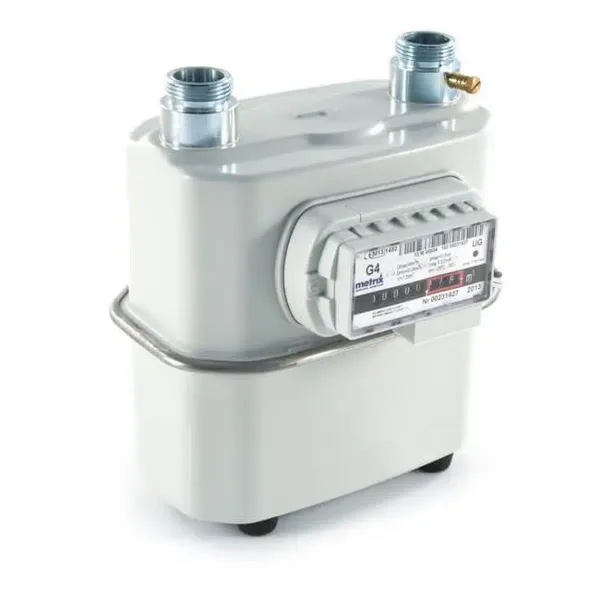
The U6 is the meter on most UK homes and small business premises. It measures up to 6 m³ of gas per hour, which supports a peak demand of roughly 65 kW: a single boiler, a small kitchen, a hairdresser's, a small shop or office. It is a compact steel diaphragm meter with a mechanical index, 1 inch BS 746 connections at 152.4 mm spacing, a built-in test point, and an optional pulse output for energy-monitoring systems. If your badge says G4, it is the same class.
Running a U6 flat out for a full year would pass 569,400 kWh, but nothing runs flat out all year: an average 2 to 3 bedroom home uses around 11,500 kWh a year, and a typical small business a few times that. It is peak hourly demand, not annual consumption, that decides whether a U6 is enough.
U16 (G10): the light-commercial workhorse
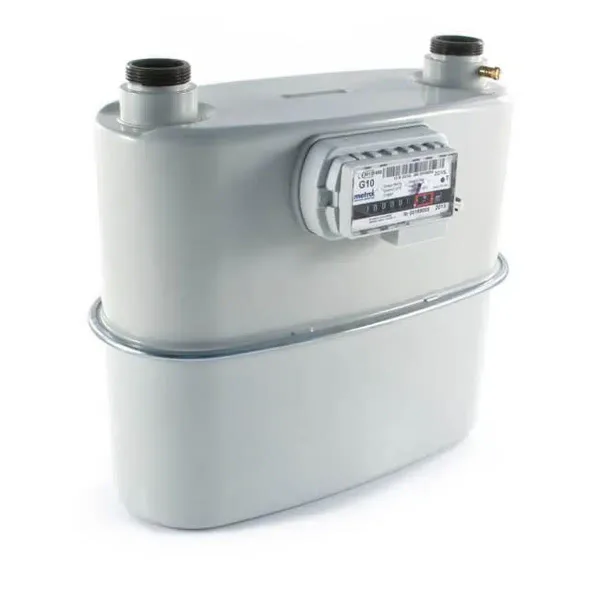
The U16 measures up to 16 m³ per hour, supporting peak demand between roughly 66 and 173 kW. This is the meter for a commercial setting running a gas kitchen plus central heating: medium-sized shops, cafés and small restaurants, and offices with real heating load. Like the U6 it is a steel diaphragm meter with a mechanical index and test point, compatible with natural gas and LPG, but the case is visibly larger and heavier.
U25 (G16): serious catering and light industrial
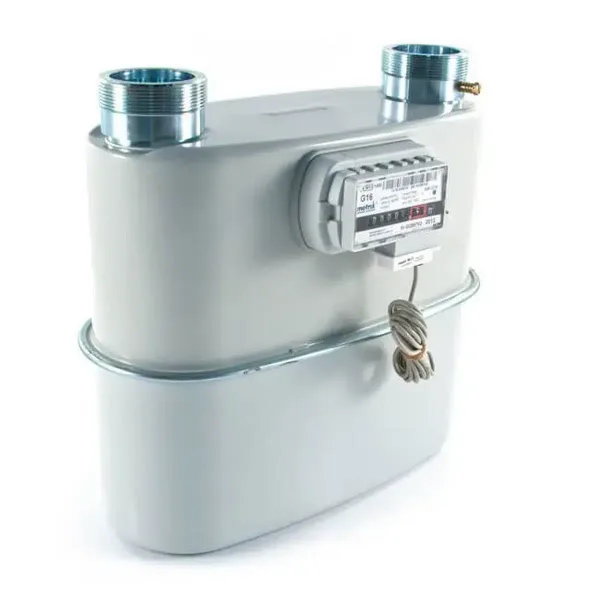
The U25 measures up to 25 m³ per hour for peak demand between roughly 174 and 271 kW: medium-sized restaurants, small hotels, and small to medium factories. It steps up to 2 inch BS 746 connections, with the same mechanical display, test point and optional pulse facility. If your kitchen or process plant keeps tripping out on gas pressure with a smaller meter, this class is usually the conversation to have.
Meter images and product specifications: Niccolo, a UK gas meter supply-and-fit provider.
The full UK gas meter range, U6 to U160
Every UK low-pressure diaphragm meter in one view, smallest to largest. Match your peak hourly demand to the meter class; the photos are the actual units.
kW values are peak demand at full load. Above U160, sites move on to rotary or turbine meters at medium or intermediate pressure: speak to our metering team for sizing.
Full specification table
| Meter | Peak demand | Capacity | Typical fit |
|---|---|---|---|
| U6 | 0 to 65 kW | 6 m³/hr | Small domestic properties or small shops with minimal gas usage |
| U16 | 66 to 173 kW | 16 m³/hr | Medium-sized shops, small restaurants, or offices |
| U25 | 174 to 271 kW | 25 m³/hr | Medium-sized restaurants, small hotels, or small to medium-sized factories |
| U40 | 272 to 430 kW | 40 m³/hr | Medium to large hotels, larger restaurants, or medium-sized factories |
| U65 | 343 to 704 kW | 65 m³/hr | Large hotels, large factories, or schools with high gas usage |
| U100 | 705 to 1,083 kW | 100 m³/hr | Industrial facilities, large factories, hospitals, or large schools |
| U160 | 1,084 to 1,733 kW | 160 m³/hr | Very large industrial facilities or large manufacturing plants |
How our gas meter installation process works
- Understand your requirements. How much gas demand will the site have? A small hairdresser's and a factory need very different meters. Work from the boiler and appliance ratings, then apply realistic diversity: you will rarely have everything running flat out at once. If you are unsure, call the gas team on 0161 521 3400.
- Run a GT1 test. The GT1 confirms whether the building has a live supply, and what pressure and pipe capacity the network can deliver. That result tells us which meter sizes the site can actually take, and whether you need a new connection or just a meter exchange.
- Make sure you are not overpaying for the gas itself. A new meter with an uncompetitive contract behind it is half a job. We tender your consumption across 30+ suppliers and advise on timing against the wholesale market, so the meter and the rate are sorted together. You can see the live wholesale prices we benchmark against, and current business gas rates by business size.
- Book the installation. Our average timeframe is two weeks when a GT1 report is already in hand, and three weeks when the GT1 is required first.
Why your gas meter size matters for procurement, not just installation
Every UK business gas contract is priced against your Annual Quantity (AQ), the kWh figure your supplier expects you to consume in a year. The meter on the wall is the cap on your peak hourly draw, but it also dictates which market you trade in:
- Up to AQ 73,200 kWh (small business): sized roughly to a U6 or small U16. Suppliers price these on standard SME panels and the contract usually has limited negotiation room.
- AQ 73,200 to 732,000 kWh (mid-market): U16 to U40 sites. Most suppliers will tender competitively here and a broker should be running 5+ quotes per renewal.
- AQ 732,000+ kWh (I&C / Large Daily Metered): U65 and up, often moving on to medium-pressure rotary meters. These sites can access flex contracts, day-ahead trading and bespoke supplier panels.
Sizing wrong in either direction is expensive: an oversized meter pays unnecessary standing charges every day, while undersized meters bottleneck production and force costly upgrades.
Common gas meter sizing mistakes we see
- Inheriting the previous tenant's meter without checking it matches your demand. A unit that was perfect for the old occupier's bakery is rarely right for a new manufacturing line.
- Sizing on installed kW rather than peak kW. Most boilers and burners only run at full load briefly. Use diversified peak demand, not nameplate ratings.
- Forgetting future expansion. Adding a second oven, kiln, or process line within 24 months is much cheaper if the meter is already a step up.
- Pricing without a GT1 test. Without confirming the supply pressure and pipe capacity, you can pay for a meter the network can't actually deliver.
How Purely Energy helps with gas meters
Most brokers walk away once the contract is signed. We don't, because the meter and the contract are the same project:
- GT1 test and meter sizing. We run the GT1 with the network operator and recommend the smallest meter that gives you headroom for growth.
- Whole-of-market gas tender. 30+ tier-1 suppliers compared, with the wholesale price, non-commodity costs, supplier margin and our margin shown separately on every quote.
- Installation co-ordination. We project-manage the connection, meter swap or upgrade: target two weeks once GT1 is signed off, three weeks if the GT1 is required first.
- Ongoing rate validation. Every renewal we test your AQ, your meter size and the wider market against your current rate. No automatic rollovers, no rolled-over commission.
Ready to start? Get a gas quote or call 0161 521 3400.
Frequently asked gas meter questions
What size gas meter do I need for my business?
Match your peak hourly demand in kilowatts to the sizing chart above. A small office or shop typically uses a U6 (up to 65 kW), a medium restaurant or hotel a U16 to U25 (66 to 271 kW), and a large factory or hospital a U65 to U100 (343 to 1,083 kW). Above U160 you're into rotary or turbine metering, give us a call for sizing.
What do U6, U16 and U25 actually mean?
The U-number is the meter's maximum throughput in cubic metres of gas per hour: a U6 passes up to 6 m³/hr, a U16 up to 16 m³/hr, a U25 up to 25 m³/hr. The G-number sometimes shown alongside (G4, G10, G16) is the equivalent European size class for the same meter. Both appear on the meter's data badge.
How long does a gas meter installation take?
Two weeks on average once a GT1 test report is in hand. If a GT1 is still required, plan for three weeks. Network capacity, region and meter pressure class can extend the lead time.
What is a GT1 test?
A Gas Transporter request that confirms the existing or proposed supply pressure and pipe capacity at your site. The GT1 result tells us which meter sizes the network can actually deliver, and whether you need a new connection or an upgrade.
Will upgrading my gas meter change my contract?
It can. Crossing the AQ thresholds (typically around 73,200 kWh and 732,000 kWh) moves you between SME, mid-market and Large Daily Metered (LDM) supplier panels, where pricing, billing frequency and contract types differ. Always run a fresh tender after a meter change.
Can Purely Energy install my gas meter?
Yes. We project-manage GT1 tests, new connections, meter swaps and upgrades for commercial and domestic sites, and we pair the install with a fresh whole-of-market gas tender so the contract behind the meter is genuinely competitive. Call 0161 521 3400 or request a callback.
© 2026 Purely Energy Ltd. Terms of use.
How we produced this article
This article was human-written by Harvey Rowlinson on 18 August 2026 and reviewed by Mark Hoffman FCA, Chartered Accountant (FCA), ICAEW on 18 August 2026. It is scheduled for its next review on 18 August 2027.
Sources
- Find your energy supplier, Ofgem (accessed 13 July 2026)
- Gas meter readings and bill calculation, Office for Product Safety and Standards (GOV.UK) (accessed 13 July 2026)
- National regulation: gas and electricity meters, Office for Product Safety and Standards (GOV.UK) (accessed 13 July 2026)
- Gas Safety (Installation and Use) Regulations 1998 (GSIUR): Approved Code of Practice and guidance (L56), Health and Safety Executive (accessed 13 July 2026)
- The Gas Safety (Installation and Use) Regulations 1998 (SI 1998/2451), legislation.gov.uk (accessed 13 July 2026)
Read our editorial standards and corrections policy.


